Summary
- C Fund, S Fund, and I Fund were all unchanged.
- EPS projections are out of line with reality.
- The AI numbers don’t add up.
Markets experienced considerable volatility over the past two weeks, particularly in the technology sector, as investors weighed persistent inflation, rising Treasury yields, and uncertainty surrounding Federal Reserve policy. Surprisingly, major U.S. stock indexes managed to finish the week higher.
Inflation remained a primary focus this week. Both the Consumer Price Index (CPI) and Producer Price Index (PPI) remained elevated, reinforcing concerns about persistent inflation. These reports highlighted the challenges facing the Federal Reserve as it attempts to bring inflation under control. Investors continued to anticipate another interest rate increase at the December meeting, with expectations favoring a 25-basis-point hike.
Technology stocks have been a significant driver of market volatility over the past two weeks, as investors reassessed valuations, regulatory uncertainty, and the substantial spending associated with artificial intelligence infrastructure. Semiconductor stocks were particularly sensitive to these concerns, contributing to broader market declines. While excitement surrounding artificial intelligence has been an important driver of market gains, elevated valuations and expectations for future earnings leave the sector vulnerable to periods of increased volatility.
Third-quarter corporate earnings have generally been strong, with approximately 90% of S&P 500 companies having reported results. Of those reporting, roughly 84% exceeded earnings expectations, while approximately 65% reported revenues above estimates.
Conservative model preview. Members see percentages for the G, F, C, S and I funds. This illustration contains placeholders only.
Sample layout. Current allocation percentages are hidden.
Reality Check
“On this day in 1929, the Dow Jones Industrial Average had one of its best days ever, surging 12.3% as John D. Rockefeller announced: ‘There is nothing in the business situation to warrant the destruction of values that has taken place on the exchanges during the past week.’ The bounce didn’t last.” (Wall Street Journal)
Fast forward to the fall of 1982, when the stock market achieved its first all-time high since 1965. Think of that: investors went 17 years before prices returned to a new peak.
On the earnings front, Joachim Klement highlighted that, since 1992, profit gains averaged 9.5% annually, less than half the rate predicted by Wall Street analysts. Moreover, in those months when C Fund profits declined (down 4.5% on average), research analysts had predicted +18.8%, a 23-percentage-point miss.
“The current 12-month forward P/E ratio of the C Fund is 18.9x, roughly in line with its 10-year average. But that holds only if we believe EPS will grow by 38.6% over the next 12 months. Meanwhile, the 12-month trailing P/E ratio is 26.2x, about 14% above its 10-year average, indicating a somewhat expensive market.”
Fund Performance
G Fund
Government securities
Return
+4.12%
Price
$20.39
F Fund
Fixed income index
Return
-1.31%
Price
$20.61
C Fund
Common stock index
Return
+9.40%
Price
$119.81
S Fund
Small cap stock index
Return
+8.78%
Price
$109.22
I Fund
International stock index
Return
+10.77%
Price
$61.47
Deep Dive
If the AI bubble bursts, it’s taking the C Fund down with it. The serious question is whether “if” is just a matter of “when.”
“There have been a flurry of studies showing that the hurdle rate on AI revenue is $2.5 to $3.5 trillion per year by 2030,” TS Lombard reports. “At $200 billion in enterprise revenue currently, that requires a massive leap…and it means consumers need to spend as much on AI services as they do on food.”
The numbers from Gartner are even more daunting:
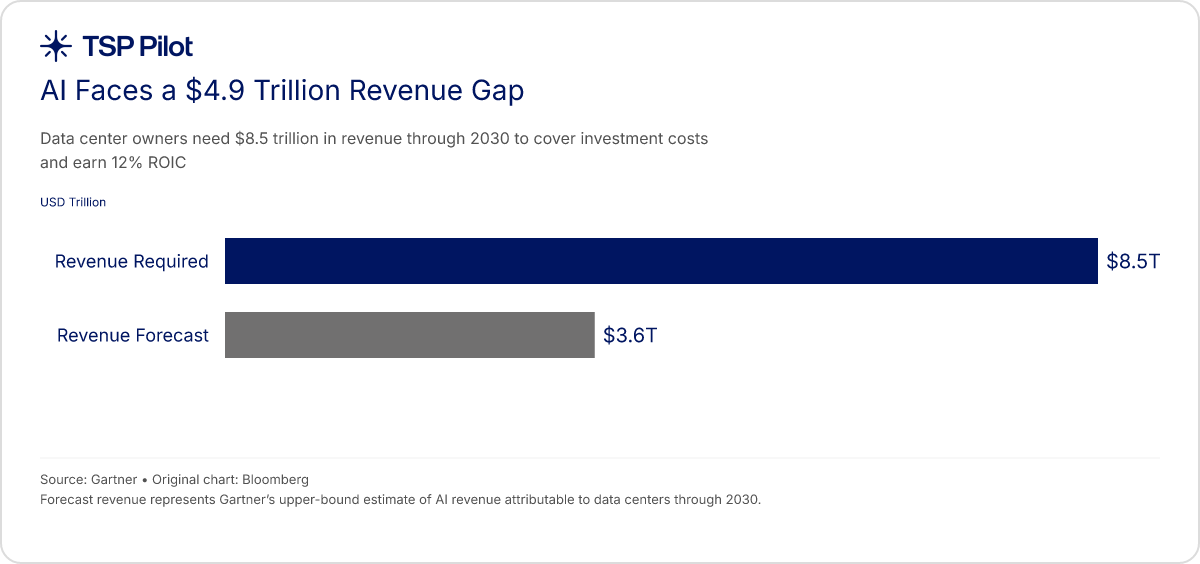
AI Faces a $4.9 Trillion Revenue Gap
Data center owners need $8.5 trillion in revenue through 2030 to cover investment costs and earn 12% ROIC
Source: Gartner • Original chart: Bloomberg Forecast revenue represents Gartner’s upper-bound estimate of AI revenue attributable to data centers through 2030.
Derek Thompson warns: “What makes AI unusual is that its biggest customers are all alike, clustering in software, media, and finance. The top 1 percent of AI spenders are also unusually likely to be backed by venture capital. According to Ramp data, 80 percent of the top 1 percent of AI spenders are VC-backed.”
And this from Nobel Laureate Paul Krugman: “Just the other day, AI enthusiasts were talking about how their miraculous technology would soon generate 10 or 15 percent a year economic growth – that was always silly. But now there’s a very real prospect that, for the next few years, AI (by empowering bad guys and forcing us to suddenly adapt to new threats) will make us poorer.”
According to analyst Paul Kedrosky: “Roughly half the critical software vulnerabilities ever found have been found this year alone. The result is an increasingly expensive, automated arms race in cybersecurity, with huge advantages for attackers and serious consequences for businesses, infrastructure, and governments. The economic costs of the Hackening will likely be enormous.”
A cybersecurity expert told Reuters: “I think we’re going to have a couple years where every single week it’s going to feel like the sky is falling.” The Exponential View on Substack went even further, calling last month’s succession of hacks “the internet’s Wuhan moment,” referencing the origin of the worldwide pandemic.
The companies building this revolutionary technology, which have powered the C Fund’s rise these past four years, are unlikely for the foreseeable future to book the revenues necessary to justify their massive investments. Moreover, they’ve released a product that to date has done quite a lot of harm…and have warned of the potential for consequences ranging from catastrophic to existential.
Even if the revenues do eventually come through and the consequences are manageable, how much will reach the bottom line? The historical record says that technological advances end up benefiting society at large rather than the bulk of corporate pioneers.
There’s an interesting irony here: the companies making the largest AI investments are those who reaped the rewards of “winner take most” markets such as search (Google), social media (Facebook), application software (Microsoft), and digital commerce (Amazon). These companies benefited from self-reinforcing “network effects” in highly profitable niches…but AI does not follow that model.
“The key distinction is not simply whether a company has a competitive advantage,” writes Torsten Slok at the Apollo Group, “but how wide and durable that advantage is, and how it shows up in the numbers: pricing power, customer retention, market share and profitability. The question looking ahead is whether, even as models become commoditized, mainstream corporate America can turn increasingly cheap intelligence into higher revenue growth and higher profit margins – that may be harder than it sounds.”
“AI may be a great calculator, but in business, intelligence is mostly judgment. Judgment depends on context, and the answer varies with which human or which model you ask. Most importantly, AI does not understand accountability, trust, culture, unwritten rules, ethical trade-offs or fairness – all of which shape reputational risk and ultimately drive revenue growth and profit margins.”
As Jim VandeHei at Axios summarized: “Any sign of overbuilding or companies underusing AI or China catching up or AI prices collapsing or credit costs spiking or the political backlash intensifying, and markets could tumble fast.”