Summary
- C Fund fell 0.8%, I Fund 2.3%, S Fund 3.1%.
- We’ve seen a historic disconnect between stocks and bonds.
- For our economy, “the future ain’t what it used to be.”
Member-only allocations
Current allocations are for members only
Start a 14-day free trial to see our current Conservative and Aggressive model allocations and the reasoning behind them.
Start free trial$0 today. Cancel anytime during your trial.
Reality Check
“During the last 76 months, the U.S. stock market has outperformed U.S. bonds by an annual pace of almost 28% -- the biggest outperformance of stocks above bonds in 100 years,” notes economist Jim Paulsen. “During the last six and one-third years, the bond market has suffered its largest decline of the last century.”
A big factor in the stock market’s rise has been the increase in profits. Corporations have posted higher earnings not only from increased sales but also by squeezing more profit out of each dollar of sales. “Pre-tax earnings hit an annualized $4.8 trillion in the second quarter, or 18 per cent of national income, according to Bureau of Economic Analysis data, the highest share since the aftermath of the Second World War,” notes Prof. Adam Tooze. “Employees’ share from wages and benefits fell to 60 per cent, the lowest level since the 1950s.”
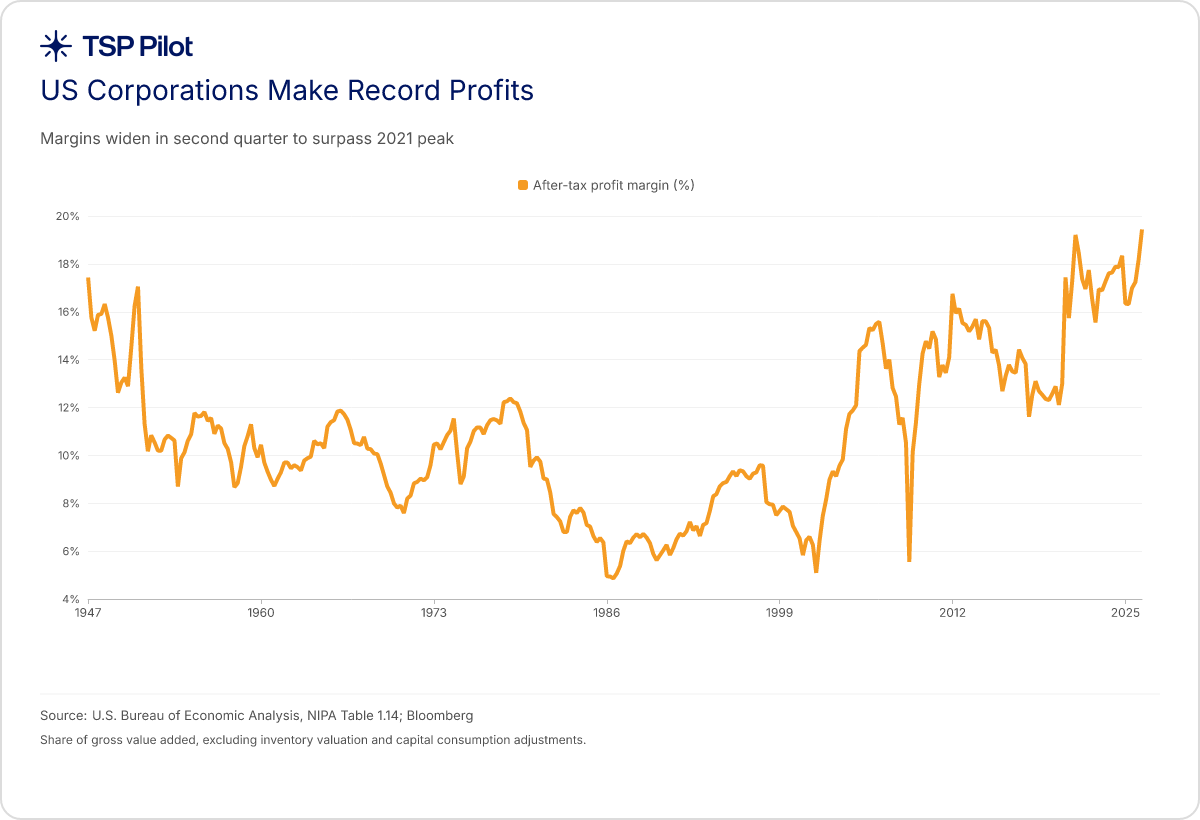
US Corporations Make Record Profits
Margins widen in second quarter to surpass 2021 peak
Source: U.S. Bureau of Economic Analysis, NIPA Table 1.14; Bloomberg Share of gross value added, excluding inventory valuation and capital consumption adjustments.
Wall Street expects this unprecedented increase in profit margins to continue for the foreseeable future. If margins turn down instead, as they likely will, the stock market is highly vulnerable.
Fund Performance
G Fund
Government securities
Return
+3.43%
Price
$20.26
F Fund
Fixed income index
Return
-2.51%
Price
$20.36
C Fund
Common stock index
Return
+12.95%
Price
$123.70
S Fund
Small cap stock index
Return
+12.35%
Price
$112.81
I Fund
International stock index
Return
+15.57%
Price
$64.13
Deep Dive
As the autumn season begins, let’s take a closer look at the pillars supporting your TSP, starting with the economy. Simply put, the economic numbers are as mixed up as they’ve ever been … but not necessarily messed up if artificial intelligence (AI) makes good on its promise.
AI has contributed fully half of economic growth for the last year. Without the massive spending by the hyperscalers—Alibaba, Alphabet/Google, Amazon, Apple, Huawei, Meta/Facebook, Microsoft, Oracle, and xAI—our economy would’ve sunk into a recession. However, if the data-center building boom triggers a bust (as we experienced with telecom in 2000–2003), the outlook will turn grim.
The backlash against data centers transcends partisanship: people don’t want these massive, unsightly, noisy, thirsty, energy-hungry structures in their communities, despite the assurances given. In addition, workers at every level feel threatened by the prospective replacement of their jobs with software and robots.
Moreover, the leading AI companies are now warning more loudly than ever that their product could pose an existential threat. It’s hardly reassuring that the only realistic solution they offer is to jointly slow the pace of the race when each of them knows that untold power and riches await the one who wins. This is the Prisoner’s Dilemma on steroids: what’s in the best interests of all is at odds with the narrow self-interest of each individual company and country.
Some will argue that end-of-days scenarios have been a feature of the entire nuclear age and that, thankfully, those fears were never realized. This sense of relief is misplaced, however. In 1961, a B-52 broke apart over Goldsboro, NC, with two hydrogen bombs on board. “Both of the weapons began their firing sequences upon separation from the aircraft, despite safeguards meant to prevent that from occurring,” Wikipedia recounts. “One of its nuclear bombs was judged by weapons engineers at the time to have been only one safety switch away from detonation.” A safeguard no more sophisticated than a light switch prevented a nightmare scenario in which radioactive fallout would’ve contaminated the Eastern Seaboard and Midwest.
The 1962 Cuban Missile Crisis is well known to all, but few understand that individual Russian submarines were given autonomy to fire nukes. One captain did, in fact, issue the launch order. An all-out nuclear war was averted only by a twist of fate: the fleet’s commanding officer happened to be on that particular sub and countermanded the captain’s order.
Similarly, in the very tense Cold War days of September 1983, a low-level Russian officer received multiple alerts from the Oko early-warning computer registering incoming U.S. missiles. He decided to ignore his standing orders and not retaliate, for which he was subsequently demoted.
Even as nuclear fears have receded, the scientists who maintain the Doomsday Clock, now in its 80th year, warn that the risks of “global catastrophe” are the highest they’ve ever been. This is particularly frightening because, as they say in boxing, it’s the punch you don’t see that knocks you out.
Stepping back from the existential to the mundane, the global economy is drowning under a wave of red ink. Our national debt now exceeds $40 trillion, three-quarters of which was taken on in just the last twenty years.
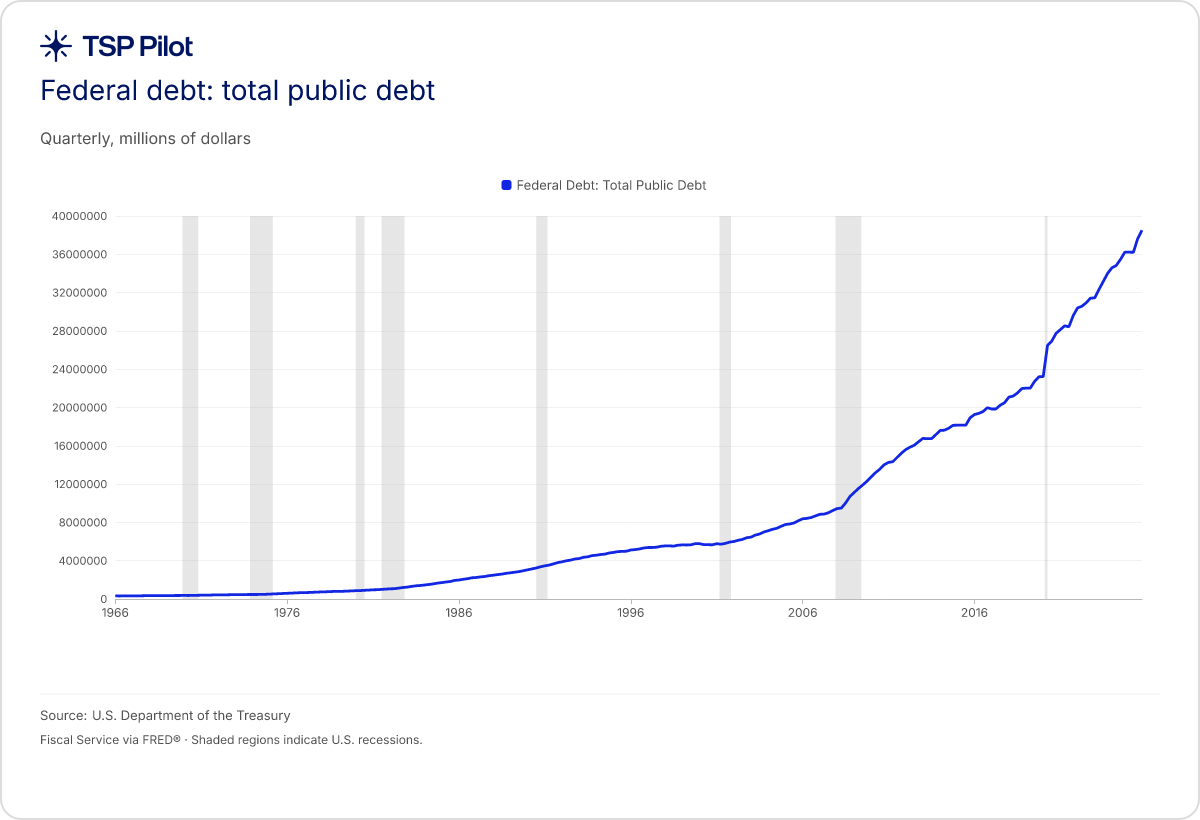
Federal debt: total public debt
Quarterly, millions of dollars
Source: U.S. Department of the Treasury Fiscal Service via FRED® · Shaded regions indicate U.S. recessions.
According to the nonpartisan CBO, federal deficits will remain above 6% of national income every year for at least the next decade—and that projection absurdly assumes no recession or financial crisis along the way. “Treasury’s own forecasts paint an even-worse picture,” Reuters reports.
As everyone knows, the annoying feature of debt for borrowers is that lenders are legally entitled to be paid back in full with interest. Even if you can keep borrowing to avoid repayment, the costs keep accumulating. For our government, interest expense now tops $1 trillion a year. More troubling is that, on an apples-to-apples basis, interest now consumes 20% of federal revenues, up from 10% a decade ago.
The net result is a debt-heavy economy in which 92% of its components are barely growing, if at all, and a Federal Reserve hamstrung by stubborn inflation. “A cocktail comprised of a Fed on pause, federal deficit spending contracting, higher bond yields, sluggish monetary growth, a flatter yield curve, some cracks emerging in credit spreads, a rising U.S. dollar, and much higher energy prices are nothing to ignore,” Jim Paulsen summarizes, adding, “Are investors already beginning to recognize that AI spending may not prove sustainable for the U.S. economy looking into the next year?”
In the upcoming two Commentaries, we’ll tackle inflation, interest rates, profit margins, and stock-market valuation.